Showing posts with label learning Korean. Show all posts

Friday, November 16, 2012

Konglish 101

When I was in Germany, I thought the amount of English words used in advertising was excessive, but Korea it seems, takes it one step further.  Konglish, the use of English in a Korean form/way, is pretty rampant here as well. A perfect example, take a look at this carton of milk below.

Goot Mo-Ning
If you could read Korean, you would read the name like this: Goot Mo-Ning Oo You.  That's right, this is Good Morning milk.  I was pretty pleased the first time I realized that, but for a lot of older Koreans and for North Koreans trying to assimilate here, it must be totally baffling trying to wade through and make sense of cutesy Konglishized English.  I even saw a sign which used Konglish, and then proceeded to italicize in English letters which word they were trying to use, in case it wasn't clear to those reading it.  

Konglish can be found everywhere here and while it is a huge help for English speakers, as long as you can read the Korean, there is one catch: you have to learn to say it in the Korean way.  Otherwise they will have a hell of a time trying to understand you.  As I learned while repeatedly trying to tell the restaurant downstairs I want my food for Take Out, instead of Tay-Ik Ow-Tuh.

Want to learn some more 'Korean'?  Here are a few words you'll likely already know:   “romance” (로맨스/romance), “telebijeon” (텔레비전/television), “keompyuteo” (컴퓨터/computer), “keopi” (커피/coffee), “diary” (다이어리/planner) and “handphone” (핸드폰/cellphone).  With a few more that you'll likely know the words, but may not know what the Koreans mean when they use them:

헌팅
"hunting"
searching for a mate
Pronounced 'Hun-Ting'*, rather than it being about shooting animals, it means going out to look for a guy or a girl, being on the 'prowl' so to speak.

미팅
meeting
blind date
This word, which we normally use for business, in Korea is meant as a date, or a blind date.

오바잇
overeat
throw up; vomit
This one threw me for a while, because the Korean spelling doesn't sound so close to the English at first listen.  O-ba- Ee-T, sounds like overeat, however the Konglish meaning is to throw up, or vomit.

There's one even for the Germans, Ah-luh-by-tuh (아르바이트) or 'arbeit', means p/t job in Korean.  They also say 'all-ba' for short.

For a complete list, have a look here.

Sunday, November 4, 2012

East Side of the ROK

Seorak mountain, like Nami Island, were places I heard were 'must visits' in Korea.  This particular mountain, while not the tallest in Korea, is an incredibly beautiful one, especially during Autumn.  Apparently droves of 135,000+ Koreans hit the trails EVERY weekend during peak season at this one mountain alone.  As Autumn is dwindling to an end, and the leaves are becoming sparser and weather colder, we decided to  make our way there before it was too late.  Seorak is one of those places you have to see to believe.  An awe-inspiring place that despite the pounding of thousands upon thousands of Korean and foreign feet that trample on its ground yearly manages to keep its astounding natural beauty.

We woke up at 4:30 am to prepare for and get ourselves to the Express Bus Terminal to catch the first bus from Seoul to Sokcho, a small seaside town.  The ride took about 2.5 hours, much shorter than is advertised on the bus schedule on the internet (they said 4+ hours!).  From there we took a taxi (although buses are available) for 20 minutes to get to the base of the mountain.  The taxi ride cost us 4,000 won ($4) and I had my first real-life Korean 'conversation'!  Normally, I practice Korean with people who speak English well or in a classroom setting, but I decided to test the waters with my non-English speaking taxi driver.  He was pretty nice.  I tried asking how long the trails were to hike and some other small talk which resulted in me understanding only 30-40% of what he responded, but never-the-less, still felt pretty proud of myself^^.

Below are some pictures from our Seorak experience.  I highly recommend it to anyone in Korea and I want to let people know it is worth the trip even if you can only stay one day like we could.

The entrance to the park with loads of Koreans posing with the bear.

The Unification Statue of Buddha: he's huge!  Just look at the size of that woman underneath him.

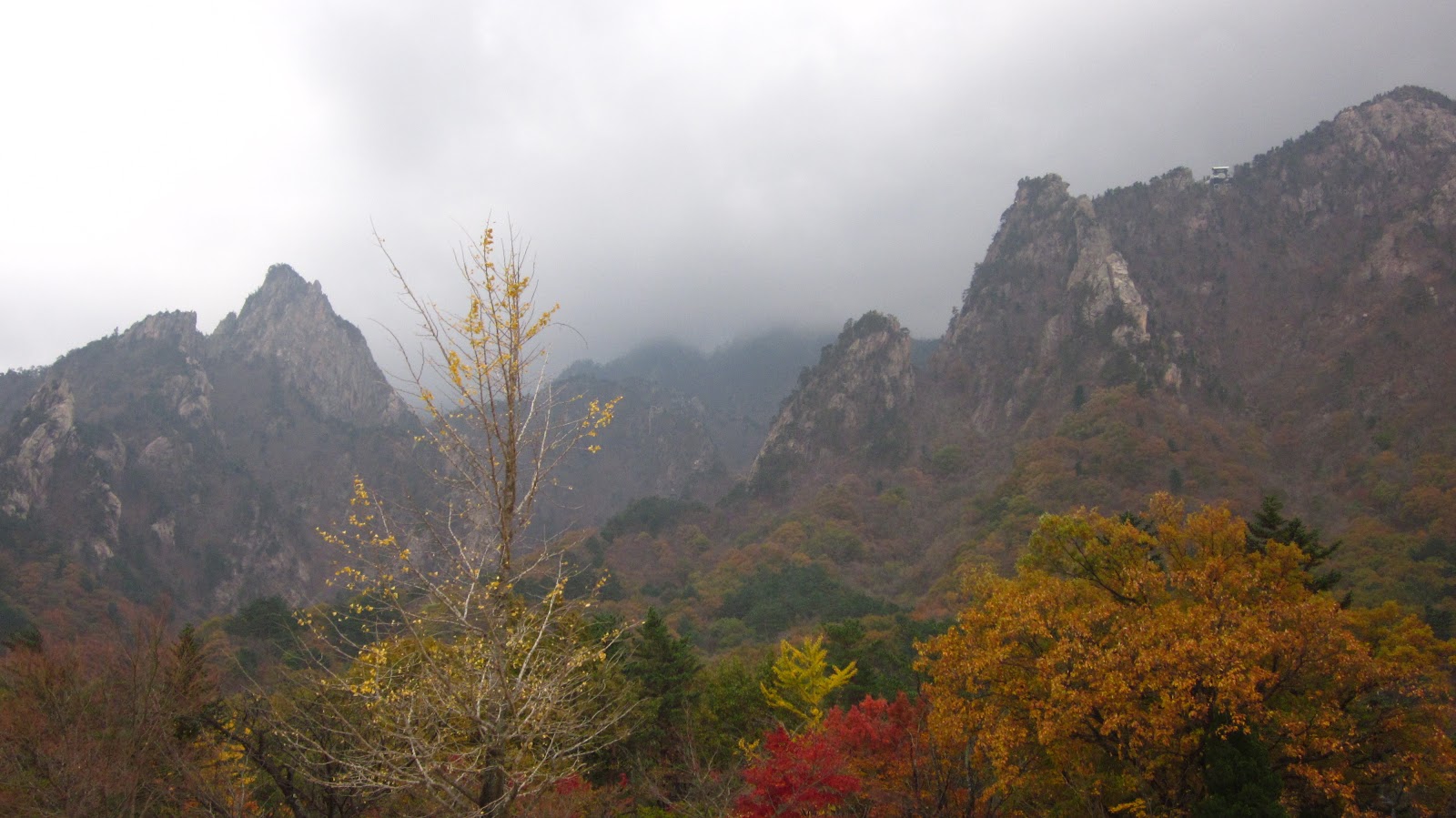
Even though many leaves have already fallen, there were still splotches of vibrant color  everywhere.  Amazing!

A view from one of the peaks:  DH standing proudly.

If you look closely those green  patches are very tiny trees.  I'm scared stiff on a cliff!

Korean flag flying high on a cold windy peak.  A park ranger chilling in his parka on top.

The biggest 'miracle' of this trip was finding a secluded area virtually people-free.  We hiked a short trail to a series of water falls and there was almost nobody there.  If you have ever been to Korea, you know that solitude is a rare commodity here.

Before leaving the park, clouds covering some of the jagged peaks.  Seoraksan, gorgeous rain or shine.
Just some advice for fellow travellers: Book your return ticket when you get to the station! Our trip was fairly smooth all the way around, but one thing we didn't forsee was that buses going from Sokcho back to Seoul would be sold out.  We arrived at the bus station at 5:00pm, but couldn't get a ticket for a bus until 8:00pm.  We managed to make it back to Seoul, but it could have been tricky if we had shown up any later.  

Thursday, August 30, 2012

Learning Korean

Next week are the final exams for my Korean class at Sookmyung University (숙명여자대학교).   There are lots of places offering Korean classes in Seoul, some for free and some not.  I started in free classes here and in addition took classes on Saturday morning at a church on the east side of Seoul.  While the obvious FREE-part was pretty sweet, the downside was that teachers and students changed often and it felt like there was little continuation from week to week.  I decided to look into paying courses, and in the end, signed up for Sookmyung's Summer Evening Program because of the price (it is one of the cheapest university programs at 450,000 won).  The class meetings are 3x a week (MWF) and books are included in the price.  I lucked out and the teacher was fantastic.  Even though my level is still beginner (1.2), I feel much more confident about my Korean studies.

There are a lot of good reasons to study Korean if you're a foreign teacher in Korea (even though many decide not to), but besides the obvious ones,  I have to say studying Korean has given me a much greater appreciation for my students and my co-teachers.  The two languages are SO different! When learning a Germanic or Romance language, there are a lot of similarities to build off of, but with Asian languages, you literally are starting from scratch again. As an English speaker, learning Korean is an option, but for Koreans, the pressure to learn English is intense and constantly there.  

Again, there are lots of options, so if you don't want to pay for classes, there are courses for free at lots of locations throughout Seoul (this link lists many of them) , and if you're not in Seoul or don't want to attend regular classes, there is also the online option.  Yonsei offers an online course for 100,000 won per level and of course, there is always the ever-popular Talk to Me in Korean website.

행운을 빌어요!

"I am learning Korean!"